As much as 80% of the plastic in the sea travelled there over land, down a drain or a river, rather than being tipped into the water directly. Once it is in the water, buoyancy decides its fate fast. Much of it sinks or washes up on a beach within a month. What stays afloat for years can end up circling in a slow-turning current for decades, or ground down small enough to reach a fish.
more
How does plastic reach the sea in the first place?
A bottle dropped on a city street rarely stays there. Rain washes it into a storm drain, and from there it travels through a stream or a river until it reaches the coast. Wind carries lighter litter the same way, off a landfill site or an overflowing bin. Out at sea, crews sometimes tip rubbish overboard, which is against the law, and a storm or a passing vessel can tear a fisher’s gear loose entirely. Once debris reaches the ocean, tracing its exact source becomes very difficult.
A 2015 study led by Jambeck estimated that about eight million metric tonnes of plastic reach the ocean this way every year.
What happens to it once it is in the water
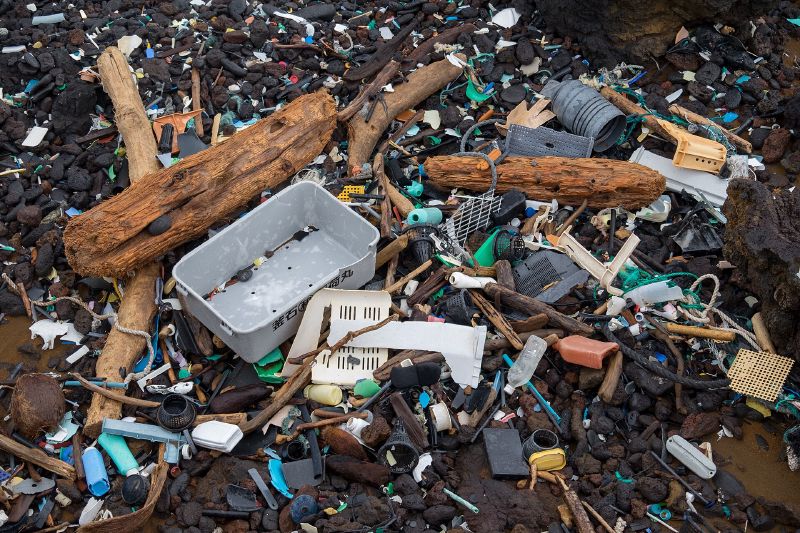
The Ocean Cleanup found that nearly half of ocean plastic sinks immediately, because it is too dense to float. Of the half that does float, about 80% washes up on a coastline within a month. That makes a beach, not the open sea, where most floating plastic actually lands. A drinks bottle usually sinks once it fills with water, while its cap, made of a lighter plastic, can travel on for far longer.
The fraction that survives years at sea can end up circling in one of five vast, slow-turning ocean currents called gyres, which trap floating debris for decades. The best known is the Great Pacific Garbage Patch, between Hawaii and California, roughly twice the size of Texas. The Ocean Cleanup describes it as a diffuse spread of fragments rather than a solid mass of rubbish.
Plastic that neither sinks nor beaches breaks down slowly in seawater. The process can take more than 400 years, according to BBC Bitesize. Sun and salt water break the plastic into pieces under five millimetres wide, called microplastic. Plankton absorb those fragments, fish eat the plankton, and people eat the fish.
The plastic that never reaches the ocean at all
Most plastic waste never gets that far. ScienceInsights reports that, worldwide, about 54% of collected plastic packaging is landfilled, 21% is recycled, and 12% is incinerated, leaving roughly 19% that escapes formal collection and eventually pollutes rivers, soil, or the air. A buried PET bottle has an estimated half-life of around 110 years, and a thicker HDPE bottle around 250 years, releasing chemicals such as bisphenol A into the surrounding ground as it sits there.
Some of that escaped plastic never touches water at all. Fragments small enough become airborne. ScienceInsights cites research recording an average of 75 particles landing per square metre a day over one coastal bay. That adds up to an estimated 1.94 trillion particles a year arriving in that bay from the air. That is why microplastic now turns up in mountain ranges and polar ice far from any coastline.
None of this traces back to a single culprit. NOAA’s Ocean Today project puts it plainly: marine debris comes from us.