About 8.6 million people lived alone in the UK in 2025, according to the Office for National Statistics (ONS), out of 29.0 million households. Nearly three homes in ten hold one person, and that share has barely moved in a decade.
more
What has changed is who those people are. Nearly half of them (49.6%) are now 65 or over. Men, once a clear minority of people living alone, have closed much of the gap with women.
How many people live alone
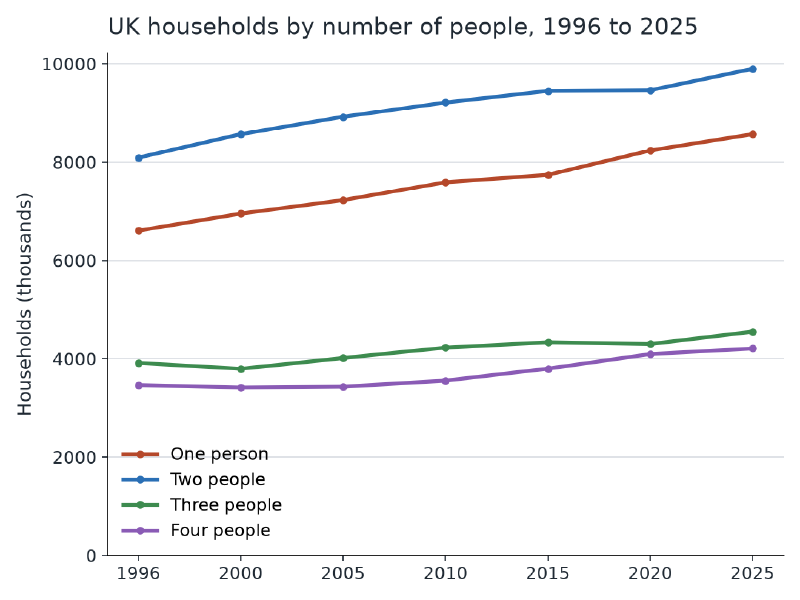
The count has climbed slowly for three decades. In 1996, 6.6 million people in the UK lived alone, which was 27.8% of all households. By 2025 the figure had reached 8.57 million, or 29.5% of households.
more
A growing population accounts for much of that. The ONS says the rise since 2015 was not statistically significant once population growth is taken into account. Homes for two remain the most common kind, at 9.9 million in 2025. The average household held 2.36 people, against 2.42 in 1996.
The share varies across the country. A study of mental health among people who live alone cites estimates that put one-person households at 36.0% of homes in Scotland and 25.8% in London. The same paper notes projections that one-person households could reach 10.7 million by 2039.
Counted as people rather than homes, the picture is similar. The 2024 bulletin found that 12.5% of people in UK households lived alone, up from 11.9% in 2014.
Why the rise is mostly over-65s
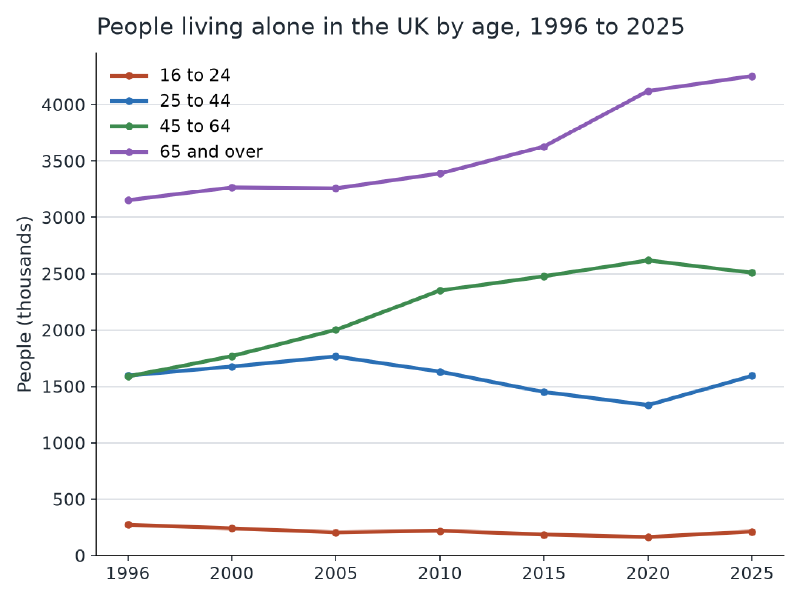
People aged 65 and over account for most of the growth. In 1996, 3.15 million people aged 65 and over lived alone. By 2025 there were 4.25 million. The ONS links the increase to the ageing population.
more
Among people aged 25 to 44, the number barely moved. It stood at 1.59 million in 1996 and 1.59 million in 2025. The youngest adults are the smallest group, with 213,000 people aged 16 to 24 living alone in 2025.
The middle-aged band is the exception. People aged 45 to 64 living alone rose from 1.59 million in 1996 to 2.51 million in 2025. The very old now form the largest single band. In 2025, 2.52 million people aged 75 and over lived alone.
The previous year’s bulletin made the same point over a shorter span. Between 2014 and 2024, people aged 65 or over accounted for the whole increase, and the number under 65 living alone held at 4.1 million.
Men are catching up
Women still make up most people living alone. In 2025 there were 4.53 million women living alone and 4.04 million men.
The gap used to be far wider. In 1996, 2.7 million men lived alone, against 3.9 million women. Men made up 41% of people living alone then, and 47.1% in 2025.
The sharpest change is among older men. The number of men aged 65 and over living alone roughly doubled, from 782,000 in 1996 to 1.54 million in 2025. Men aged 45 to 64 followed a similar path, from 744,000 to 1.36 million.
Older women living alone still outnumber older men. Of people aged 65 and over who live alone, 63.9% are women and 36.1% are men. The ONS says longer life expectancy for women may explain the difference.
Measured as a share of everyone that age, the 2024 bulletin found 40.9% of women aged 65 or over living alone, against 27.0% of men. The men’s figure had risen from 21.9% in 2014, while the women’s showed no significant change.
How new is this?
Living alone on this scale has almost no precedent. K.D.M. Snell, a historian at the University of Leicester’s Centre for English Local History, studied lists of inhabitants from pre-industrial Europe, North America and Japan. He also traced British censuses from 1851 to 2011.
Many pre-industrial settlements had no single-person households at all, Snell found, and the average was around 5% of homes. The steep rise came in the twentieth century, and above all from the 1960s onwards.
He puts the modern UK figure at 31% of households. In some European and North American cities, he notes, single-person homes reach 60% or more.
Alone is not the same as lonely
Snell draws a line between being alone, which a census can count, and feeling lonely, which it cannot. Loneliness can strike in a crowded city or a family home.
The ONS measured loneliness through the Community Life Survey in 2016 and 2017. It found 5% of adults in England felt lonely often or always, about one in 20. The loneliest group was not the oldest. People aged 16 to 24 reported feeling lonely more often than older age groups.
The analysis did pick out a profile that overlaps with the solo household. Widowed older homeowners who live alone and have long-term health conditions were one of three groups at particular risk. People who were single or widowed were more at risk in general. Women reported feeling lonely more often than men, and renters more often than people who owned their homes.
How firm the numbers are
The ONS builds these estimates from the Labour Force Survey. Smaller samples in recent years have made them less certain, although the ONS says sample sizes are improving.
That matters for year-to-year moves, which are small. The ONS put people living alone at 8.43 million in 2024 and 8.57 million in 2025. The three-decade climb from 6.6 million is a different matter, and it is the change the age and sex figures explain.
What the health research finds
Two UK studies have looked at how people who live alone fare, and both find a gap.
The first pooled ten longitudinal population surveys, covering 37,544 people, with about 16 million electronic health records from the OpenSAFELY-TPP platform. Before the pandemic, the researchers found, people living alone reported more psychological distress and lower life satisfaction. That gap did not change during the pandemic. The paper notes that during lockdowns, people living alone saw the steepest fall in face-to-face contact with others.
In the health records, the study found depression recorded in 26 more people per 100,000 among those living alone. For severe mental illness the excess was 58 per 100,000. The authors suggest that people who live alone may face greater barriers to treatment, and say health planners should take that into account.
The second study, by Jessica Abell and Andrew Steptoe at University College London, followed 4,888 people from the English Longitudinal Study of Ageing for an average of 8.5 years. Living alone was linked to a higher risk of death, with a hazard ratio of 1.20. That held after allowing for socioeconomic status, physical health, health habits and loneliness.
The route into living alone made the difference. People who began living alone after divorce or bereavement carried a higher risk, with a hazard ratio of 1.34. Those who came to live alone for other reasons, such as children or others leaving, showed no increased risk. Depression, loneliness and limited mobility explain part of the link, the authors write, but how it works remains poorly understood.
Abell and Steptoe conclude that the reasons people stop living with others complicate the link. Understanding them, they write, would help identify who is most at risk. With 4.25 million people over 65 now living alone in the UK, that is a question about a very large group.