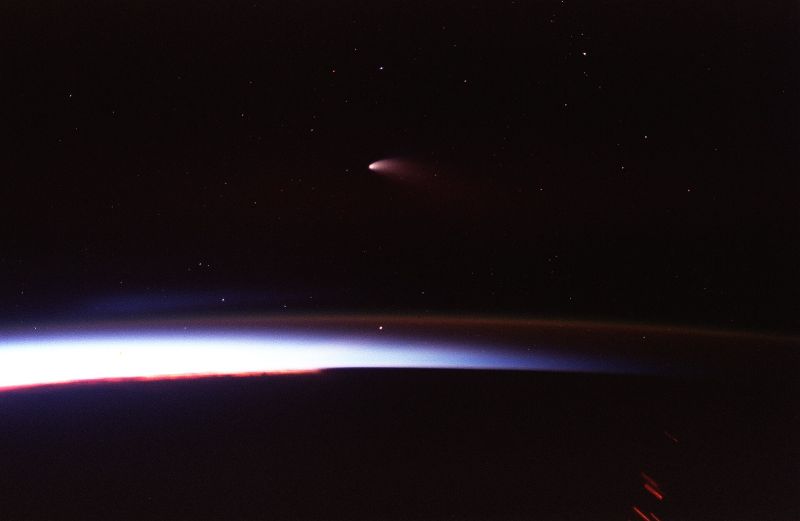
A comet’s tail points away from the sun, not away from wherever the comet has just been. Sunlight and the solar wind push gas and dust off the icy nucleus as it nears the sun. Neither force has anything to do with which way the comet itself is heading.
more
That fact undoes the usual mental picture: smoke behind a chimney, or a scarf trailing a runner. A comet’s tail isn’t exhaust from its motion. It’s material the sun pushes outward, and the sun doesn’t care which way the comet happens to be going.
What a comet is before it grows a tail
The word comes from the Latin cometa, meaning “long-haired”. The earliest known sighting on record was logged by an astrologer at the Chinese court in 1059 BC. Most comets formed alongside the sun and planets, from the same cloud of gas and dust. They were later flung out to the solar system’s far edges. Scientists think roughly 100 million comets now orbit the sun. Most come from a distant, roughly spherical reservoir called the Oort Cloud, which reaches over halfway to the nearest star.
At the centre of every comet sits a nucleus of frozen water and gases mixed with dust and rock, often called a dirty snowball. Nuclei run from a few kilometres across down to smaller ones, with the tiniest known, 322P/SOHO, only 100 to 200 metres wide. Far from the sun, that nucleus is all there is. It carries no coma and no tail.
How the coma forms
Once a comet’s orbit carries its nucleus close to the sun, solar heat evaporates the icy outer layers. The dust and gas that escapes builds a hazy cloud around the nucleus, called the coma. The coma grows larger the closer the comet gets, and the sun’s heat and radiation are what set the whole process going.
A comet also carries an invisible hydrogen envelope, around the coma and part of the tails. It’s made of neutral hydrogen atoms, freed when solar radiation splits water vapour apart. The envelope shows up only in ultraviolet light, which never reaches the ground because Earth’s atmosphere blocks it.
A comet has no light of its own. What a viewer sees is sunlight reflecting off the comet, plus the coma’s gas releasing energy it absorbed from the sun.
Two tails, two different pushes
Most comets grow two tails once the coma has built up enough material, and each one answers to a different force. The dust tail is made of grains roughly the size of smoke particles. Sunlight’s pressure shoves the grains outward. The heavier ones keep some of the comet’s own orbital motion, so the tail curves back toward the comet’s path. It glows pale, whitish-yellow simply by reflecting sunlight.
The gas takes a different route. Solar radiation ionises the gas in the coma. The solar wind, a stream of charged particles racing outward from the sun’s corona at 300 to 800 kilometres a second, then sweeps up that charged gas. Its magnetic field drags the gas into a long, straight, blue-glowing ion tail, aligned with the wind rather than with the comet’s path. The blue comes chiefly from ionised carbon monoxide.
Between the two, a bright comet’s tail can run to roughly 150 million kilometres. Seen from Earth, the whole structure can bloom many times larger than a planet.
Why “away from the sun” beats “behind the comet”
The dust tail curves. The ion tail doesn’t. But neither one trails behind the comet the way exhaust trails a car. Neither of the forces shaping them has anything to do with which way the comet is heading.
Author Stephen P. Maran, a retired assistant director of space sciences at NASA’s Goddard Space Flight Center, compares the comet to an old-time courtier and the sun to an emperor. The courtier never turns his back on the emperor, whichever way the comet’s orbit runs. On the way in toward the sun, the tail streams out behind the comet. Once the comet rounds the sun and heads back out, the tail still points away from the sun. The comet ends up following its own tail rather than dragging it.
A disconnection event makes the point hardest to argue with. It happens where the comet crosses a boundary in the solar wind, a spot where the wind’s magnetic field flips direction. The stretched field lines there snap and reconnect. The whole ion tail is cut free at once, and a new one grows in its place. Comet Encke’s ion tail was severed completely on 20 April 2007, as it crossed a coronal mass ejection. The STEREO spacecraft watched the whole event happen. Comet C/2025 A6 (Lemmon) lost part of its own tail the same way on 2 October 2025. Only the ion tail breaks like this. The dust tail answers to sunlight, not magnetism, so it comes through unaffected.
German astronomer Ludwig Biermann worked out why in 1951, years before anyone detected the cause directly. Measuring photographs of comet tails, he found ionised gas moving outward faster than 400 kilometres a second. That was too fast for sunlight’s gentle pressure to explain on its own. Biermann concluded that a continuous stream of charged particles had to be pouring off the sun. Eugene Parker named that stream the solar wind in 1958. Spacecraft such as Mariner 2 confirmed it within a few years, on its way past Venus. Comet tails had picked up the solar wind about ten years before any spacecraft flew through it directly.
A comet from outside the solar system, watched the same way
The rule holds for visitors from beyond the solar system too. On 1 July 2025, the NASA-funded ATLAS survey telescope in Rio Hurtado, Chile, picked up a new interstellar object, named 3I/ATLAS. The Hubble Space Telescope photographed it on 21 July 2025, when it was about 446 million kilometres from Earth. The images showed a teardrop-shaped tail off a nucleus up to 5.6 kilometres across.
The sun is bright enough to overwhelm most telescopes that would otherwise watch a comet approach it. So NASA turned to spacecraft built to stare at the sun directly. One is the coronagraph aboard the Solar and Heliospheric Observatory, which blocks the sun’s disk to see its faint outer atmosphere. That instrument caught 3I/ATLAS at its closest approach to the sun, on 30 October 2025, about 203 million kilometres out. The object won’t come closest to Earth until around 19 December, when it will be about 1.8 times the average distance between Earth and the sun. After that, it heads back out into interstellar space for good.