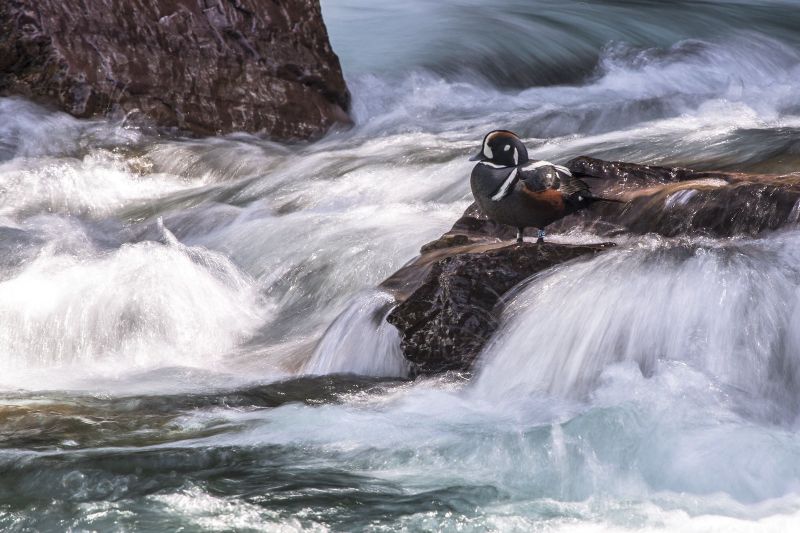
A duck’s foot does not stay warm on ice. It stays cold, and that is the point. The blood vessels in a bird’s leg pass heat from outgoing blood to returning blood, so the foot runs close to the temperature of the ice. A cold foot loses far less heat than a warm one would, and the bird’s core keeps the heat it needs.
more
The foot never quite freezes, though. Living Bird, the Cornell Lab of Ornithology’s magazine, describes chickadees whose feet cool to close to 30°F while their bodies stay hot. Birds generally hold a core temperature of about 105°F.
The heat exchanger in the leg
The trick has a name: counter-current circulation. The Natural History Museum in London says birds carry it in the legs of every species.
Arteries carrying warm blood down to the foot run right beside the veins bringing cooled blood back up. As the two streams pass, heat moves from the artery into the vein. The returning blood is warm again before it reaches the body. The outgoing blood arrives at the foot already chilled, so it has little heat left to lose to the ice.
Birds can also change how fast blood flows to the feet. The museum credits that control, together with the exchanger, for keeping a penguin’s feet from freezing as it stands on ice. Some whales use the same arrangement in their flippers and tails.
Why not keep the feet warm?
Most animals put the core first. Keeping the internal organs at a steady temperature matters more than warm extremities, the museum says. Your own hands go cold first in winter for the same reason.
It would cost too much food. Every bit of heat a bird sends to its feet has to be replaced by burning fuel in the core, the Living Bird article explains. A bird that kept its feet at body temperature would lose heat so fast that it could not eat enough to keep up.
The feet still get blood the whole time. That steady flow keeps the tissue alive and flexible. Chickadees stand on bare, unfeathered legs all winter, and their toes keep working at any temperature. The article notes that human toes of that size would freeze in seconds.
Does a bird mind? It probably feels cold differently. Living Bird suggests a bird would not register discomfort until its tissue actually began to freeze.
Standing on one leg
Watch a mallard on a frozen pond and you may see it balanced on a single leg. Ducks, geese, gulls and herons often rest that way, with the other leg pulled up into the belly feathers.
The arithmetic is plain. With one foot tucked away, a bird halves the heat it loses through its bare legs, according to the BirdNote programme published by Audubon.
Smaller birds use a variant. Sparrows and juncos fluff their feathers down over both legs in the cold. They also tuck their bills into their shoulder feathers, not under a wing as the saying goes.
Feathers do the rest
The feet are the weak spot, so the rest of the body is wrapped up. A bird fluffs its feathers to thicken the insulation, which is why chickadees can look twice as fat in winter. Small extremities help too, because a larger surface sheds more heat.
Night is the hardest stretch, because no food comes in to replace the heat spent. Small birds shelter in tree holes and let their body temperature drop to narrow the gap with the air outside.
The foot on the ice is where all that insulation stops. What saves it is blood that was cooled before it got there.