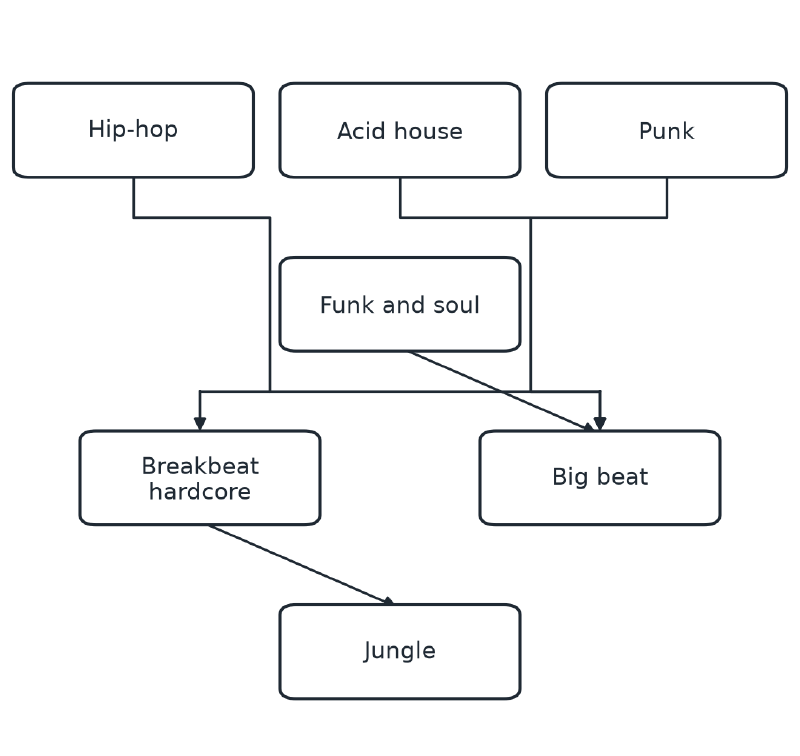
Big beat ruled the late 1990s because it reached people who never went to clubs. Hip-hop breakbeats, acid house noise and punk attitude turned rock and indie fans into ravers, in Norman Cook’s own phrase. The Prodigy took the sound to No 1 in Britain and America. Then it crashed almost as fast. Cook, who recorded as Fatboy Slim, says a style built to break the rules became a formula that anyone could copy.
more
Where breakbeat and big beat came from
Big beat got its name from a club night. In the mid-1990s Cook and his circle were fusing hip-hop breaks with acid house, and the new sound had no name. DJs and journalists tried “tripno”, “Brit hop” and “amyl house”. The name that stuck came from Cook’s Brighton night, the Big Beat Boutique. He liked the company it put him in. House music took its name from Chicago’s Warehouse and garage from New York’s Paradise Garage, and now a genre took its name from a night in Brighton.
more
The drums underneath are older than any of those clubs. Resident Advisor traces them to Kool DJ Herc, who arrived in the West Bronx from Jamaica in 1967. At his block parties, Herc saw that dancers moved hardest during the percussion break of records by James Brown and Sly and the Family Stone. With two copies of one record, he could stretch that break for up to five minutes. Grandmaster Flash took up the style, and hip-hop followed soon after. Billboard credits Afrika Bambaataa with helping to pioneer breakbeat DJing, and his 1982 single “Planet Rock” fused the young sounds of dance and rap.
The Lisbon DJ Inês Coutinho, who plays as Violet, explains why the drums never wore out. A breakbeat, she told the Guardian, is a drum cut from funk and pop, so it is “a part of the collective unconscious”.
How rave sped the breaks up
Britain met those drums through acid house. Billboard says Phuture’s “Acid Tracks”, made in Chicago in 1987, all but started the UK rave scene by the end of the decade. By the early 1990s rave had a rowdier offshoot. The Guardian calls the hardcore scene acid house’s “snottier, spottier, breakbeat-driven kid brother”. Richard Russell, who later ran XL Recordings, says it sounded suburban, like Essex, and that everyone in it was a DJ, a producer and a label at once.
Russell’s own hit shows how the scene worked. With XL’s co-founder Nick Halkes, he took a beat from a Marley Marl hip-hop track and sped it up. Over it went a cassette of a friend playing a nightclub bouncer. “The Bouncer” came out as Kicks Like a Mule and reached No 7.
The Prodigy did the same thing with more flair. Their 1991 single “Charly” set hardcore piano and sped-up rap samples against clips from a 1973 public information film about a boy and his cat. So many records copied its trick of borrowing hooks from children’s television that Pitchfork says a whole “toytown techno” scene grew up behind it. Mixmag later asked on its cover whether “Charly” had killed rave.
Not every breakbeat record of the time was a cartoon. The BBC says clubbers wanted something new as acid house peaked, and found it in the breakbeats of the Future Sound of London’s “Papua New Guinea”. Billboard notes that its bassline came from Meat Beat Manifesto’s “Radio Babylon”. Acen’s “Trip II the Moon” of 1992, which Pitchfork files as hardcore “in the breakbeat sense”, built its track on a chipmunk-falsetto vocal.
Where the breaks split
At Rage, the rave night at Heaven in London, the second-room residents Fabio and Grooverider took over the main floor in 1991. Mixmag says their blend of breakbeat hardcore, techno and ragga pulled the scene in a new direction. By about 1993 the drums ran at twice the speed of the basslines. That was jungle, which Mixmag calls the first club sound of wholly British origin.
Then the law stepped in. The Criminal Justice Act set out to curb raves, down to the playing of “repetitive beats”. In a 1994 interview, Liam Howlett of the Prodigy said licences for big outdoor events had dried up. A crowd of 20,000 a year earlier would now be lucky to reach 10,000. Rave moved indoors and split into factions: techno, jungle, progressive house and garage. Howlett had moved away from 180bpm breakbeats himself. He kept using breaks, though, because hip-hop would always be part of him.
A Sunday night in a pub basement
Big beat grew in the space that split left behind. In August 1994 Heavenly Records started a Sunday night in a London pub basement. Mixmag puts the first run at 13 Sundays in the Albany on Great Portland Street, in a room that held about 150. The residents were two Manchester DJs who then called themselves the Dust Brothers. Andrew Weatherall and Justin Robertson played too, and acid techno sat next to hip-hop and rock. Mixmag’s verdict is blunt: “Big Beat was born.”
The Guardian describes the Sunday Social as chaos at a time when Ministry of Sound and Cream were polishing themselves into brands. Tricky once played a set there of heavy metal records at the wrong speed. Heavenly’s Robin Turner wrote of huge freakbeat breaks and riffs from battered 1970s synths, taped back together.
Damian Harris, who founded the Skint label, says the timing was right. Around 1995, he wrote, dance music had grown bloated and purist. That left a gap for people raised on John Peel, acid house, hip-hop and punk. Harris won Skint as an offshoot of Brighton’s Loaded Records, on a three-release trial with two conditions: no house music, and no losing money. His brief to Cook, he told DJ Mag, joined the swagger and breaks of hip-hop to the elation of acid house and a rock attitude. Cook later put his own formula the same way: breakbeats from hip-hop, the rebellion of punk, the energy of acid house and the hooks of pop.
Who built the sound
Mixmag names the three acts that showed big beat to the world: Fatboy Slim, the Chemical Brothers and the Prodigy. They came from very different places. Two were history students, one was an Essex rave crew, and one was a pop veteran on his third career.
Two students in Manchester
Tom Rowlands and Ed Simons met at Manchester University in 1989, where both studied history. Within weeks they were DJing together as the Dust Brothers. They loved records with big beats and bigger noises, could not find enough of them, and decided to make one. “Song to the Siren” came out as a white label in the summer of 1992, pressed with a £300 loan from a friend. Junior Boy’s Own reissued it early in 1993.
They had borrowed their name from the American production duo who worked with the Beastie Boys, on the theory that they would never get famous enough to be noticed. They were noticed. After a polite but firm letter from the US Dust Brothers, Rowlands suggested a new name taken from their track “Chemical Beats”. Their first live show was at Weatherall’s techno club Sabresonic. Too shy for the stage, they played from the back of the room, with their sequencers set up on a makeshift toilet block.
The Sunday Social made them. Through the second half of 1994 they were sometimes turning away 500 people a night. Their taste did not travel everywhere. They were booked for a 9am set on the terrace at Space in Ibiza, and lasted about half an hour before they were asked to leave. Rowlands remembers clubbers in tears, and one going to fetch the manager.
An Essex rave crew
Liam Howlett was born in 1971 and grew up in Braintree, Essex. His first concert was Afrika Bambaataa at Wembley. He DJed through the acid house summer of 1988 and learned to make music on a Roland sampler and a Moog Prodigy synthesiser. The band took its name from the Moog. At a beach party, a raver called Keith Flint praised Howlett’s set and asked for a tape. Flint and his friend Leeroy Thornhill joined as dancers.
Richard Russell knew early that they would be huge. “His drums were better, bigger, harder,” he says of Howlett. Russell also saw something of the Specials in them: a mixed-race line-up that connected with kids. The debut album Experience produced five hit singles in 1992. The 1994 follow-up, Music for the Jilted Generation, went to No 1 in the UK. Rolling Stone says the band’s real leap happened on that record, where Howlett slowed the breaks down and gained weight.
A pop veteran in Brighton
Norman Cook had already topped the UK charts twice. The Housemartins reached No 1 with “Caravan of Love”, and his group Beats International did it in 1990 with “Dub Be Good to Me”. He came late to acid house, and Pitchfork says he largely missed rave’s first wave. Around the age of 30 he finally fell for it, bought a Roland TB-303 and worked hard to learn its quirks. He made house records as Pizzaman and the Mighty Dub Katz.
His band Freak Power had a contract that barred him from releasing records elsewhere, so he hid behind aliases. When he took a residency at the Concorde in Brighton, Norman Cook and Fatboy Slim were billed as two different DJs. He told DJ Mag the name came from old blues records. A fat blues singer gets called “Slim”, so he liked the contradiction.
Harris’s first Skint release was Cook’s “Santa Cruz”, issued in 1995 as SKINT 1. It sold about 800 copies. On his first visit to the Heavenly Social, Cook heard the Dust Brothers playing it. He compared the moment to finding his long-lost family. Back in Brighton, he started the Big Beat Boutique with Harris and the promoter Gareth Hansome. Within weeks there were queues down the block. In 1998 the dance monthly Muzik named it the 39th best club of all time.
The rest of the gang
A scene gathered around them. Jon Carter of Monkey Mafia and Richard Fearless of Death in Vegas were residents at the Social alongside the Chemical Brothers. Cook told DJ Mag that meeting them there felt like a meeting of minds, a gang who liked music that was not quite like anyone else’s. DJ Mag calls Bentley Rhythm Ace big beat’s in-house band.
Mixmag’s list of the best big beat tracks from before 1998 widens the circle. It includes the Crystal Method, Cut La Roc, the Lo Fidelity Allstars, Death in Vegas and an early Groove Armada. It also credits Skint with steering the genre’s path. Cook looked west too. He paid tribute to American producers such as the Bassbin Twins, the Crystal Method and DJ Shadow, anyone mashing up breakbeats “the wrong way”.
The records that defined big beat
The Chemical Brothers’ debut came first. Exit Planet Dust took three weeks to record, and it opened with “Leave Home”, which the press release sold as “The Prodigy meets Motorhead”. Muzik’s 1995 interview with the duo, reprinted by the Guardian, predicted it would be the year’s most eclectic dance album, running from hip-hop to acid to funk to techno.
Firestarter
Then the Prodigy changed shape. In 1996 Howlett promoted Keith Flint from dancer to frontman and vocalist. Flint shaved the middle of his head, dyed and spiked the patches either side, and lined his eyes with kohl. “Firestarter” went straight to No 1 in the UK in March 1996, knocking Take That off the top. Its squealing riff came from the Breeders’ “S.O.S.”, and its shouted “hey” from the Art of Noise. The Mail on Sunday called for a ban. Pitchfork says the BBC got more complaints when the video aired on Top of the Pops than it had over the Sex Pistols.
The single also went gold in the US. British dance acts had struggled to sell there since the acid house boom of 1988. The Fat of the Land followed in 1997 on Madonna’s Maverick label, which had won the bidding war. It went to No 1 on both sides of the Atlantic, a feat the Guardian calls unprecedented for a British dance act. It went on to sell well over 10 million copies. Its third single, “Smack My Bitch Up”, caused an uproar, and Kmart and Walmart stopped selling the album.
Dig Your Own Hole
The Chemical Brothers released Dig Your Own Hole on 7 April 1997. Clash says two big beat records defined that year, and this was one of them. Its single “Setting Sun”, sung by Noel Gallagher, went to No 1. “Block Rockin’ Beats” built its groove from a Bernard Purdie drum break and a Schoolly D vocal from his 1989 track “Gucci Again”. The BBC says the track took sampling to a new level and set up a wave of alternative dance mixed with hip-hop. The album closes with “The Private Psychedelic Reel”, nine minutes of sitar, noise and clarinet. DJ Mag calls it the most ambitious thing the duo have recorded.
Fatboy Slim’s two albums
Better Living Through Chemistry, Cook’s 1996 debut as Fatboy Slim, peaked at No 69 in the UK. Its title was partly a salute to the Chemical Brothers. Cook says he made it so he would have enough records in the new style to fill a whole Boutique set.
The follow-up came fast. In a single week, Cook wrote “Praise You” and “Right Here, Right Now”, along with a third track for the album. You’ve Come a Long Way, Baby came out in October 1998. He took the title from a pair of charity-shop boxer shorts, not knowing it was an American cigarette slogan.
“The Rockafeller Skank” shows his method. Cook took a throwaway intro by the rap producer Lord Finesse, cut it into syllables and played them back from a keyboard. Under it ran a Just Brothers guitar riff and surf twang lifted from Duane Eddy. Billboard calls the result the big beat essential.
“Praise You” came from a compilation Cook bought for £8.25 at Rhythm Records in Camden. Its last track was Camille Yarbrough’s “Take Yo’ Praise”, which opens with her singing alone. Skint paid Yarbrough for the sample before release, and Harris says she liked the respect Cook had shown it. The single went to No 1 in the UK in the first week of January 1999. Spike Jonze’s video showed a made-up community dance troupe performing outside a Los Angeles cinema. MTV at first turned it down for looking home-made. It still carried the song into the US Top 40, Fatboy Slim’s only visit there.
Cook’s remixes sold as well as his own records. His take on Wildchild’s “Renegade Master” reached No 3 in January 1998, and his remix of Cornershop’s “Brimful of Asha” went to No 1. You’ve Come a Long Way, Baby spent four weeks at No 1 in the UK. Cook remembers one week when the album knocked Robbie Williams off the top and he won a Brit award.
How big beat spread, then crashed
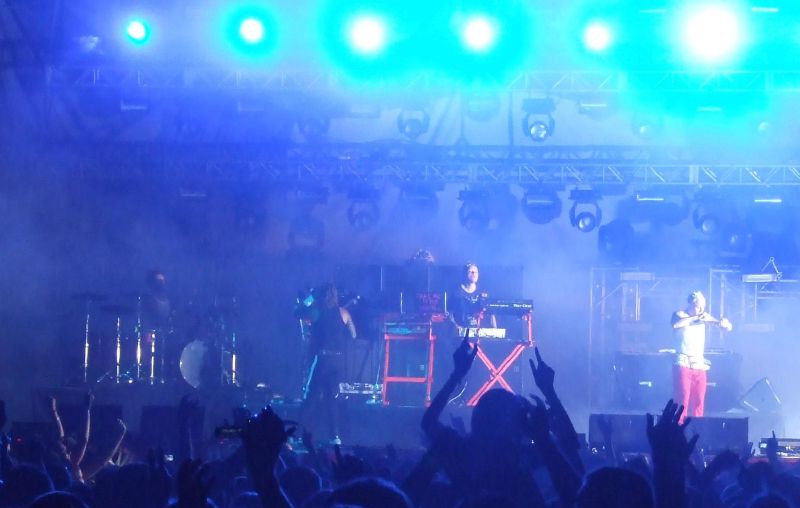
Big beat’s real trick was reaching people who did not go to clubs. Somebody wrote that Fatboy Slim made dance music for people who don’t like dance music, and Cook took it as a huge compliment. Harris says some called it lager music because you did not need drugs to enjoy it. That, with all the guitars, made it easier for the NME to love. Fatboy Slim made the NME’s cover. Clash calls big beat electronic music for the NME crowd. Its stars had the bold personalities of rock musicians rather than the faceless image of most dance producers.
more
Indie and dance shared the same rooms. Underworld’s Karl Hyde remembers the Heavenly Social as a great place for mixing. For him, Noel Gallagher working with the Chemical Brothers said it all.
How America heard it
In the US, Pitchfork says, the Chemical Brothers and the Prodigy made electronica for an alt-rock audience, which suited Hollywood’s music supervisors. A 1999 Rolling Stone feature listed Fatboy Slim’s licensing deals, from Air Jordan adverts to the films Go and Office Space. Cook shrugged it off. Fifteen seconds of his music, he said, and it made complete sense. Rolling Stone later called “The Rockafeller Skank” a true only-in-1998 hit, from the moment electronica went populist. Its list of the greatest EDM albums says Cook became the first EDM artist to enjoy real US Top 40 success.
Not every act crossed so easily. The Prodigy toured Music for the Jilted Generation across America in matching tracksuits, and many US rave fans were unimpressed. The album never made the Billboard 200.
Bigger stages
The rooms kept growing. Cook found himself following the Foo Fighters at T in the Park, with a table and a couple of record players where a band’s backline would usually stand. On the long walk to the decks, he says, he turned into “Captain Showboat”, part Mick Jagger, part Liberace. In 2002 the second Big Beach Boutique drew more than 250,000 people to Brighton’s seafront. Cook paid £30,000 towards the emergency clean-up. In 2004 he played to an estimated 360,000 people in Rio de Janeiro.
Why it crashed
Harris watched the scene turn sour. Success took it from small, sweaty clubs to huge arenas, he wrote. A more laddish crowd arrived, cocaine spread, and the DJ sets got too predictable. Big beat became a dirty word, and the sound ended up as the stock soundtrack for action film trailers.
Cook told DJ Mag the backlash came because the music got dull very quickly. The idea had been to break the rules that kept house, rap and rock apart. Instead it became a new set of rules, and once everybody copied it, the formula crashed and burned. He and his friends raced each other to get out. When they asked what their next albums would sound like, the answer was “anything but big beat”.
The Heavenly Social closed in February 1999. The Chemical Brothers played for three hours on its final night, and ended with Flowered Up’s “Weekender”. Their 1999 album Surrender took its rush from the trance nights at Gatecrasher in Sheffield. On 2002’s Come With Us, DJ Mag says, the breakbeats went and the four-four pulse of house came in. By then the big beat scene was dead in the water. Clash says the genre had fallen by the wayside by 2000.
Pitchfork traces the afterlife. In Britain, the nimbler 2-step garage became pop’s new pleasure. In America, advertisers rather than labels kept big beat going. A 2001 Mitsubishi advert turned the Wiseguys’ “Start the Commotion” into a hit, and a Nike campaign did the same for Junkie XL’s 2002 remix of Elvis Presley’s “A Little Less Conversation”. Nu-metal and rap-rock became the main buyers of breaks. Pitchfork calls the Avalanches’ Since I Left You, built in 2000 from charity-shop vinyl, a contender for the last great big-beat album. Rolling Stone counts an estimated 3,500 samples on it.
Where breakbeat stands now
Breakbeat did not stop when big beat did. The word “breaks” settled on a separate club scene. London’s Bar Rumba hosted one of its defining nights, Friction, run by Adam Freeland, Rennie Pilgrim and Tayo. The sound travelled. In April 2002 Resident Advisor reviewed a Sydney party called “History of Breaks”, with Kid Kenobi among the DJs and a 45-minute wait to get in. The Guardian is less fond of that era. By the time “breaks” had entered the vocabulary next to its cousin big beat, it says, originality had burned out. What was left included novelty records such as DJ Deekline’s “I Don’t Smoke”.
The old Brighton crowd still turns out. At a 2010 charity reunion at the Concorde 2, Bentley Rhythm Ace played again, sirens and cardboard car included. Cut La Roc, who had since moved into breaks, scratched over the Wiseguys’ “Ooh La La”. Cook DJed that night sober. He had checked into rehab in 2009. Afterwards, he said, his first five sober shows left him so rigid with fear that he could not dance.
Breaks come back
A younger generation has picked the drums back up. In 2019 the Guardian reported breakbeats returning to clubs where the four-four thud of house and techno had ruled for decades. It credited a wave of queer DJs and producers, led by Chicago’s Eris Drew and Lisbon’s Violet. “Nothing cracks your body quite like them,” Drew said.
DJ Mag found young producers chopping old jungle and hardcore breaks into new shapes. Tessela, the alias of Ed Russell, made “Hackney Parrot” that way. Some lines still hold. Daniel Koehler told DJ Mag the Amen break is now so common that it is unplayable, and the one break he has never sampled. Bicep’s “Glue”, from 2017, mixed breakbeats with ambient chords and acid house. The BBC says it helped producers such as Ross From Friends and Mall Grab break through.
The founders carry on
The Chemical Brothers recorded 2019’s No Geography on much the same kit they used for Exit Planet Dust. That year they and Cook played fundraisers to save the Social, the venue Heavenly opened in 1999. Their influence reached further than their records. The Guardian says the duo’s vast light show plainly shaped the stage shows of America’s EDM stars. Billboard says Cook went on inspiring a new generation of DJs when dance music swept the US in the late 2000s. Keith Flint, the face of “Firestarter”, died in 2019.
Cook has marked 30 years of Better Living Through Chemistry with a remastered reissue full of B-sides and rarities. He says the passion for making new music has gone, though not the passion for DJing. In one year he played 115 shows. Pitchfork’s verdict on his peak still stands. Three decades after the first Heavenly Social, musicians keep trying their hand at big beat, and nobody has done it better than Fatboy Slim.
Starter guide
Hear these first. They run in order of release, from rave’s breakbeat cartoons to big beat’s peak.
- Charly (The Prodigy, 1991). The Guardian’s reprint of a 1994 interview calls it a classic breakbeat track, and Mixmag calls the 12-inch seminal.
- Firestarter (The Prodigy, 1996). Pitchfork names it among the 250 best songs of the 1990s, and Billboard among the 100 best dance songs of all time.
- Block Rockin’ Beats (The Chemical Brothers, 1997). It appears on Billboard’s 100 best dance songs and on Mixmag’s 10 best big beat tracks from before 1998.
- Dig Your Own Hole (The Chemical Brothers, 1997). Rolling Stone ranks it among the 30 greatest EDM albums, and Clash names it one of two records that defined 1997.
- The Fat of the Land (The Prodigy, 1997). NME puts it among the 500 greatest albums of all time, and Mixmag calls it a seminal album.
- The Rockafeller Skank (Fatboy Slim, 1998). Billboard calls it the big beat essential, and Rolling Stone puts it among the 98 best songs of 1998.
- You’ve Come a Long Way, Baby (Fatboy Slim, 1998). Rolling Stone ranks it among the 30 greatest EDM albums, and Billboard calls it a classic.
- Praise You (Fatboy Slim, 1999). Billboard’s critic puts it first among Cook’s 10 best songs, and Rolling Stone puts it among the 99 best songs of 1999.