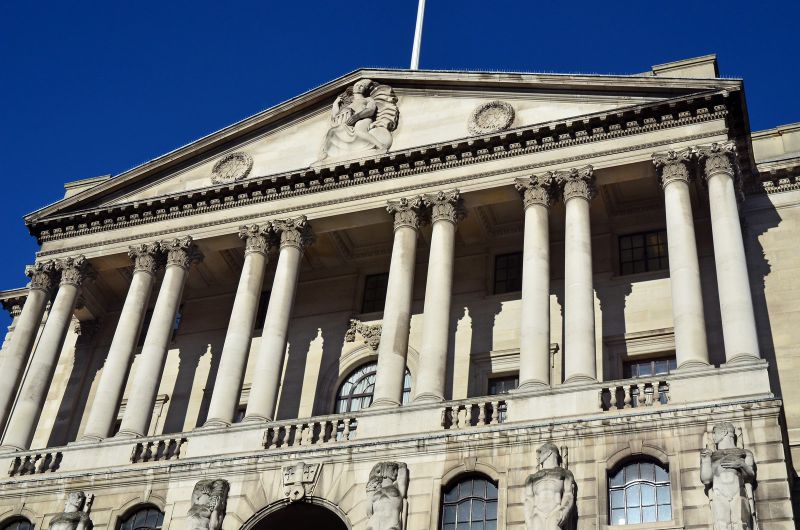
The Bank of England raises its Bank Rate to make borrowing dearer and saving more rewarding, so that spending cools and price rises slow with it. The rise reaches a mortgage or a loan long before it reaches a supermarket till, and it does not reach every borrower on the same day or by the same amount.
more
Between November 2021 and its most recent rise, the Bank increased its rate fourteen times in succession, taking it to 5.25%, the highest level since 2008. Inflation itself had peaked at 11.1% in October 2022 before falling back to the Bank’s 2% target by May 2024, the first time it had done so in almost three years. Not every household felt that arc on the same day, and some did not feel it as the same size of shock at all.
How a rate rise reaches a mortgage
The Bank’s Monetary Policy Committee, nine people who meet eight times a year, votes to raise, hold or cut the rate. A change in Bank Rate feeds into the saving and mortgage rates that banks and building societies charge people and businesses. The Committee publishes the minutes of each vote, along with a Monetary Policy Report four times a year setting out the analysis behind it.
The Bank also holds a second lever it built during the low-rate years: a stock of government bonds bought through quantitative easing, worth £875 billion between the 2009 financial crisis and 2021. It has since begun selling those bonds back, a move first announced in August 2022 that runs alongside the rate rises rather than in place of them.
Why the Bank raises rates at all
Its target is to keep the Consumer Prices Index rising by about 2% a year. Energy and food costs, pushed up by Russia’s invasion of Ukraine, drove much of the recent overshoot, and rising UK wages added to it. Dearer borrowing is meant to discourage the loans and big purchases that keep demand, and prices, running hot.
Not every price rise responds to that lever the same way. A University of Portsmouth analysis argued that recent UK inflation was driven less by demand outrunning supply than by rising costs for manufacturers and service providers themselves. That kind of inflation is what economists call cost-push, rather than demand-pull. A dearer loan works mainly on demand, so it has less to bite on when the costs pushing prices up sit on the production side instead.
Why the squeeze takes so long to land
A rate rise does not reach every borrower at once. Anyone on a fixed-rate mortgage pays nothing extra until that deal ends. The Bank’s own financial stability analysis, published in July 2023, said it would take time for the full effect of higher rates to come through. How sharp that effect turned out to be would depend on how households and businesses chose to adjust their spending and saving once it did.
Bank Rate itself had already climbed from 0.1% to 5% between December 2021 and June 2023, a sharp rise after a long run of very low rates. UK ten-year government bond yields rose by more than 300 basis points over the same stretch. More UK mortgages sit on variable or short fixed-rate deals than in some other countries. The Bank’s analysis found the strain lands more on households than on the banking system, relative to countries where longer fixed-rate lending is the norm.
Who ends up paying most
Higher rates squeeze demand in general, not any one household, but the burden does not land evenly. Imperial Business School economist José-Luis Peydró and colleagues traced how a change in rates moves through household income and wealth. Their data set was close to three decades of Danish tax records, some 70 million individual observations in all. They note that dearer mortgages and consumer loans can hit a household directly. Any recession those higher rates help bring on lands hardest on lower income households, on top of the fuel and food costs already squeezing them.
Run their data the other way and the tilt shows up in numbers. A one percentage point cut in rates lifted the income of the top 1% of earners by 5% over two years, against 0.5% for the lowest earners. Asset values moved further apart still. The same cut added the equivalent of 20% of a poorer household’s disposable income to its property and shares over two years, against 75% for the richest. The wealthy simply held more property and shares to begin with. Younger households fared worse than older ones on both counts, since it is older, wealthier households who hold most of the investments and property that a change in rates moves.
None of that reverses neatly for a rate rise rather than a cut. But whoever has the least income to spare and the fewest assets to fall back on is also whoever has the least room once borrowing gets dearer.
The numbers behind that squeeze are concrete enough on their own. When the Bank raised its rate by a quarter point to 1% in May 2022, analysts at Hargreaves Lansdown estimated the move would add more than £40 a month to the average mortgage payment. Widen the lens, and the Office for Budget Responsibility projected that UK household debt-servicing costs would climb from £55 billion to £83 billion over the two years that followed the 2022 rate rises. Renters were exposed too, since buy-to-let landlords carrying their own mortgages tend to pass higher borrowing costs on to tenants.
What a cut would undo
Pushing rates up to fight inflation works by slowing the economy on purpose, and the Bank knows it. In June 2024, governor Andrew Bailey said he had seen “strong evidence” that the fall in inflation was working its way through the economy. He stressed the Bank had to be sure it would stay at the 2% target, rather than dip and rebound.
Cutting the rate again would ease the squeeze on borrowers, and revive the same spending a rise was meant to slow in the first place. The Bank cannot do both at once. Every rate it sets is a choice about which of those two problems to risk next, not a way of avoiding either.