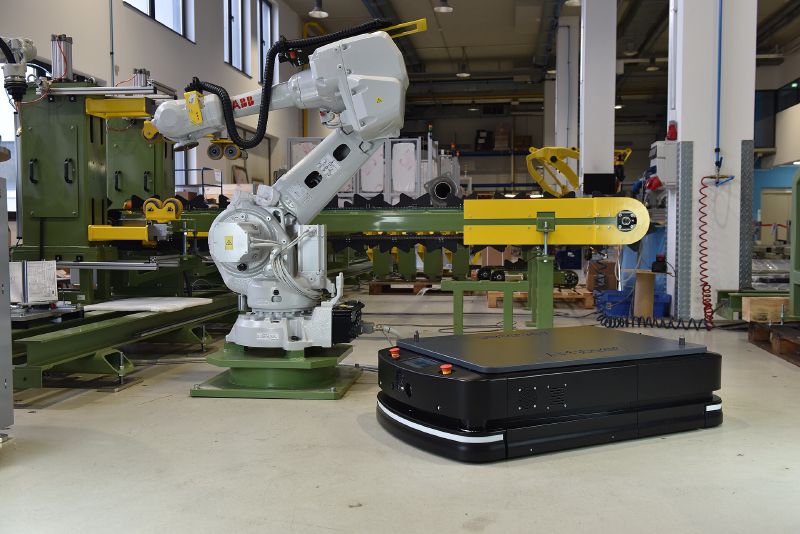
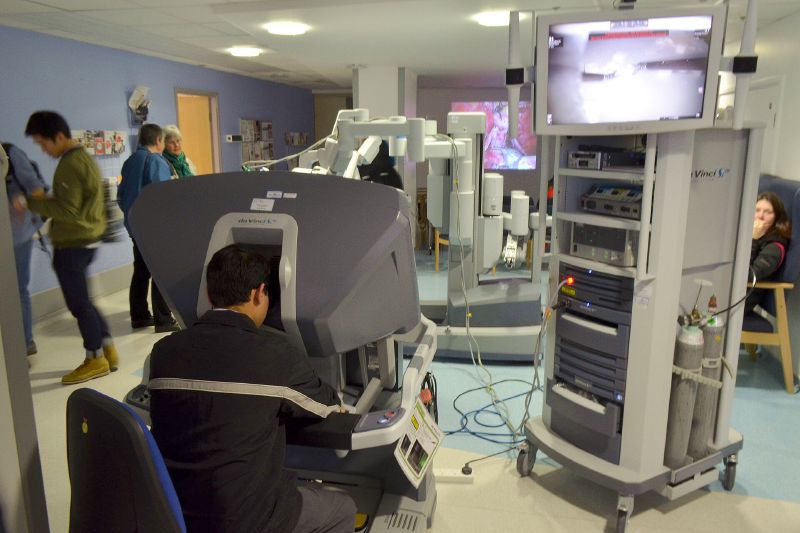
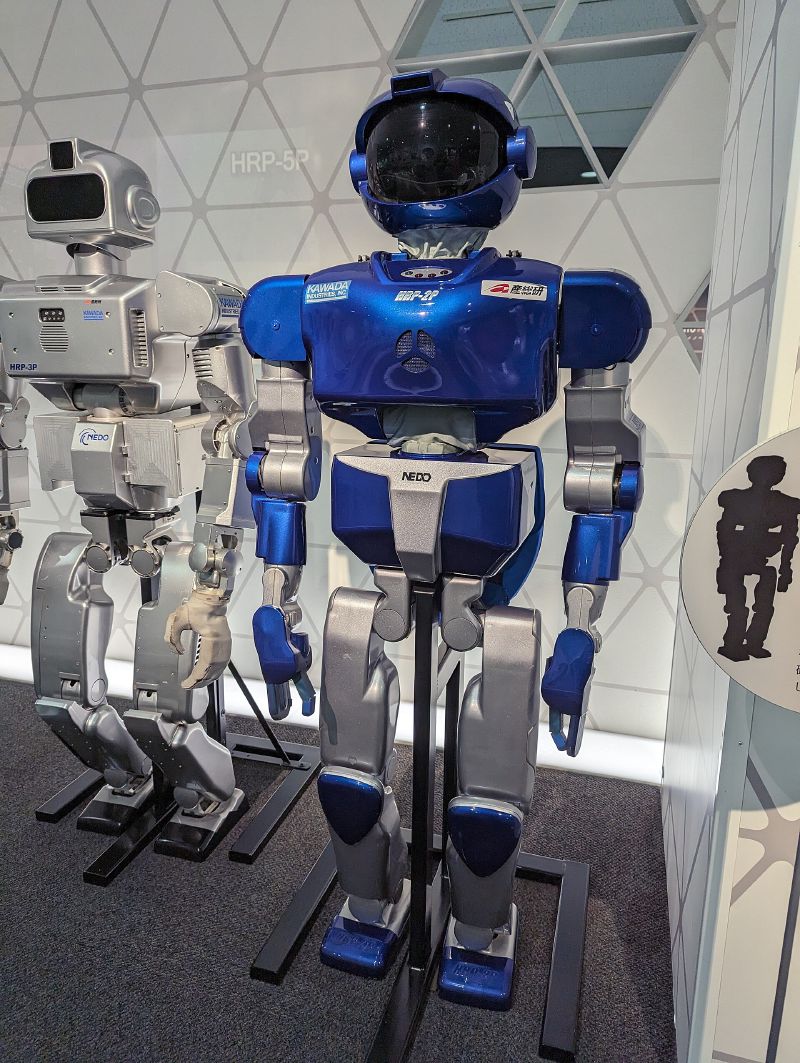
A humanoid robot has to solve several of robotics’ hardest problems inside one machine: balancing on two legs, matching a human hand’s grip, and reading a room that refuses to sit still. None of those is a new problem by itself. Stacking all three into one body, then asking it to work all day beside people, is what makes the humanoid version so much harder than any one piece alone.
more
Robotics has tried this before, in public, and mostly failed. In 2012 the Pentagon’s Defense Advanced Research Projects Agency, DARPA, set a multi-year contest to push disaster robots forward. Gill Pratt, the scientist who designed it, is now chief executive of the Toyota Research Institute. When the contest’s finals ran in 2015, the machines fumbled through tasks a person barely notices doing: opening a door, driving a golf cart, using a power tool. Clips of the robots stumbling and falling went viral.
Jerry Pratt, a senior research scientist who led the team that came second at that 2015 contest, is now chief technology officer at Figure AI. It is one of several startups betting the descendants of those machines are close to useful work. Others making the same bet include Agility Robotics, 1X, Apptronik and Tesla. Elon Musk visited the 2015 contest in person before deciding to build a humanoid of his own.
Why a hand is still the part nobody has matched
A human hand carries more than 30 muscles and 27 joints, laced with tendons and ligaments that give it 27 degrees of freedom, and more than 17,000 touch receptors in the palm alone. Matching that has defeated engineers for centuries. The earliest attempt on record is a spring-loaded iron hand built for a 16th-century German knight, and the first robotic hand with any sense of touch was not built until 1960s Yugoslavia.
What has changed, according to Eric Jing Du, a professor of civil engineering at the University of Florida, is that robots are gaining what researchers call embodied AI. As Du puts it, embodied AI “perceives, understands, and reacts to the physical world” rather than only handling data about it. A soft-fruit picking robot that lifts a strawberry into a punnet without crushing it is one product of that shift. A robot hand that matches a person’s for ordinary, everyday use is not yet.
Legs solve one problem and create several more
Climbing stairs is one task where legs earn their keep. Two advances helped make a two-legged machine practical: better computer vision, and power-dense batteries that came out of electric-car development. Together they gave a humanoid enough onboard power to catch itself mid-stride, the way a person recovers from a slippery patch of pavement.
The trade-off is that two legs are an unstable base by default, so every step needs constant correction. Jonathan Hurst, a professor at Oregon State University who co-founded Agility Robotics, chose a physics-first approach over copying human anatomy exactly. Agility’s Digit walks on legs shaped more like an ostrich’s than a person’s. Melonee Wise, the company’s chief technology officer and a former chief executive of the wheeled-robot company Fetch Robotics, argues legs let a machine handle stairs, ramps and uneven ground. They also let it squeeze into narrow gaps, and bend low or reach high without a separate lift mechanism. Reliability, not ambition, is what she says the industry still has to prove: “the secret to success in robotics is failing gracefully.”
The brain is the harder half
Gill Pratt argues the deeper shift of the past decade is not in the machines’ bodies at all. “What’s different now isn’t the body, but the brain,” he told IEEE Spectrum. Robots once needed a line of code written for every action. The AI advances of the past few years let a robot instead be shown a task and learn to repeat it, without a programmer writing out each step.
What still limits that approach is data: how much demonstration a robot needs before it can generalise, and what that demonstration should contain. Pratt compares the argument to one already running inside large language models. Researchers there disagree about whether patching up errors is enough, or whether, as Yann LeCun argues, a machine instead needs “world models” that let it imagine how a scene will unfold before it acts.
Training a robot takes a lot of amateur video
Getting that demonstration data has become an industry of its own. Micro1, a company based in Palo Alto, California, pays gig workers in more than 50 countries to film themselves doing household chores such as folding laundry and washing dishes. It then sells the footage to robotics firms. Zeus, a medical student in Nigeria, records himself for the company at $15 an hour. He says the repetitive filming does not suit him: he would rather have “a technical job that requires me to think.”
Investors put more than $6 billion into humanoid robotics in 2025. Ali Ansari, Micro1’s chief executive, estimates robotics companies now spend upwards of $100 million a year buying data of this kind, from his company and rivals such as Scale AI and Encord. China has taken a more centralised route: state-owned training centres there fit workers with virtual-reality headsets and exoskeletons to teach robots simple tasks, including opening a microwave.
Not everyone thinks the timeline is close
Rodney Brooks, the roboticist who founded iRobot, has warned that money pouring into humanoid startups such as Figure is inflating a bubble, and that robots will not master hand dexterity well enough to be useful for a long time.
Fady Saad, a general partner at the robotics-focused venture firm Cybernetix Ventures, told TechCrunch he sees little real market for humanoids beyond replacing astronauts in space. He also worries about what happens when one falls on a child or a pet at home. Seth Winterroth, a partner at the venture firm Eclipse, frames the same doubt in engineering terms: ordinary software already strains at six degrees of freedom, and a humanoid runs on “60-plus degrees of freedom systems.”
Sanja Fidler, Nvidia’s vice-president of AI research, compares the current excitement to the early years of self-driving cars. Those felt close to solved around 2016, and still have not reached full autonomy everywhere a decade on. Nvidia’s chief scientist, Bill Dally, agrees with her.
Tesla is the clearest case of a timeline slipping. The company announced its Optimus robot in 2021 and said the following year it would arrive in 2023. It unveiled the robot in 2024 at a live event, and the robots were later revealed to have been largely controlled by humans off stage. Tesla now says it will begin selling the robots in 2026. Figure, meanwhile, was valued at $39 billion in a funding round last September, even as it faces questions, which the company disputes, about how many robots it has actually deployed.
Brooks does not doubt that a useful robot built to do a person’s physical work is coming. He doubts it will look like the ones on stage now. His prediction is that the version that actually works will run on wheels rather than legs, built for the job rather than in our image, and that it remains more than a decade away.