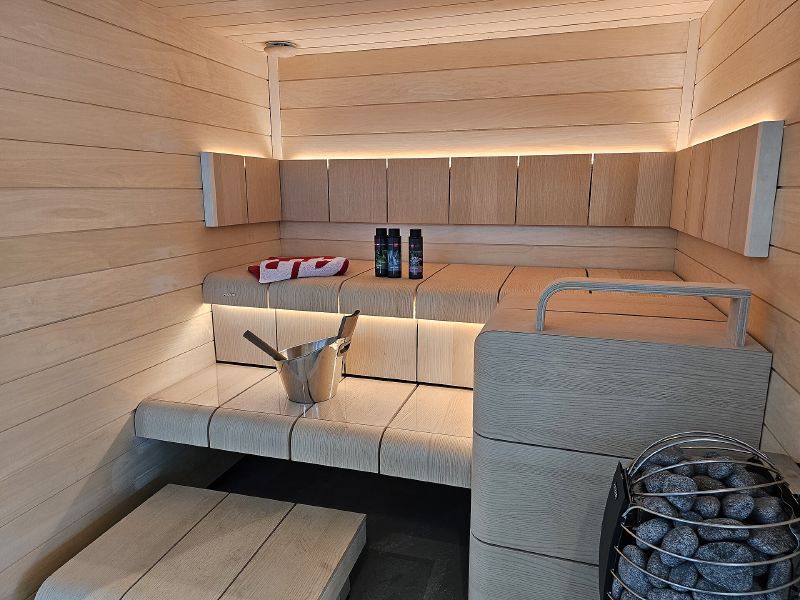
Finland has an estimated 3.3 million saunas for a population of 5.6 million. Many sit in ordinary homes, and the habit goes back further than the country itself.
more
The city of Tampere alone has about 60 public saunas serving roughly 250,000 residents, enough to earn it the title “sauna capital of the world”. One of them, Rajaportti, opened in 1906 and still runs on a seven-hour wood heating routine that starts at 7am. In 2020, UNESCO added Finnish sauna culture to its list of the world’s intangible cultural heritage.
Where the habit started
The sauna itself is far older than any building that houses one. Its origins are thought to reach back 10,000 years, to a pit dug into the ground and lined with hot stones. Dalva Lamminmäki, who researches sauna culture as a folklorist at Finland’s University of Eastern Finland, describes the earliest version: once the stones had heated in a campfire, the pit was covered with wattle, thatch or peat, and water thrown on the stones made steam.
That basic method, heat stones and add water, has not changed. What changed was what people used it for. Beyond washing, Finnish saunas served as places to cook, dry flax and rye, make soap, do laundry, tend the sick, wash the dead before burial and give birth. A weekly sauna also marked the change from one week to the next, cleansing people ahead of church and the Sabbath.
A space with its own rules
That range of uses gave the sauna a social role that outlasted its practical one. At Rajaportti, the single room splits into sections for men and women, with a gap under the dividing wall that young children can crawl through. Regulars check on each other if someone misses their usual slot, and some visitors spend an hour washing away the working day while others stay for hours with friends. Some saunas discourage talk of politics, business or religion. At Rajaportti, nothing is off limits.
Much of the atmosphere comes down to löyly, the steam that rises when water hits the hot stones. Alexander Lembke, who heats Rajaportti and calls himself a “sauna classicist”, compares good löyly to an intense hug, and says its quality can shift within the same sauna from hour to hour as the heat drops.
Why it carried a spiritual weight
The sauna’s older role went beyond hygiene and household chores. Lamminmäki says it was considered sterile, warm and private, and thought to carry the power of ancestors and deities. In her account, the building itself stood at a threshold, somewhere between the living and the dead. Emma O’Kelly, author of the book Sauna – The Power of Deep Heat, writes that the ancient Finns worshipped the four elements there and treated it as a microcosm of the sky world, the earth and the underworld. Much of that mythology survives in the Kalevala, Finland’s national epic, and the sauna’s role as a symbol of Finnish identity still shows up in gods and goddesses carved into sauna doors and windows.
Formal recognition of that spiritual side did not last into the modern state. Finland outlawed folk healing in 1890, and speaking about the sauna’s supernatural side became taboo from then on.
Why it stuck
What survived was the practical habit, scaled up until it became a fixture of the ordinary Finnish home rather than a luxury. Unlike countries where a sauna session is marketed as an expensive treat, in Finland it sits in the everyday routine, and many older Finns were born in one. Finland has topped the World Happiness Report rankings for six years running, and the Guardian asks whether the sauna plays a part. At Rajaportti, Lembke says, people of every background sit together and talk, and it sometimes gets heated.