In 2021, a team at University College London built the most complete model yet of the missing front of the Antikythera mechanism, the corroded bronze device pulled from a Greek shipwreck in 1901. The model fits every surviving fragment and matches the inscriptions cut into the mechanism’s own casing. Nobody has yet shown that a Greek workshop of the period could have built it.
The reconstructed front needs nested tubes to carry pointers for the sun, moon and the five planets known at the time. Tony Freeth’s team found room for them all only by fitting the tubes into a space 25 millimetres deep. A modern machinist would turn each tube on a lathe. Whether anyone in the first century BC had a tool that precise is the question the model cannot answer on its own.
more
What divers pulled from the wreck in 1901
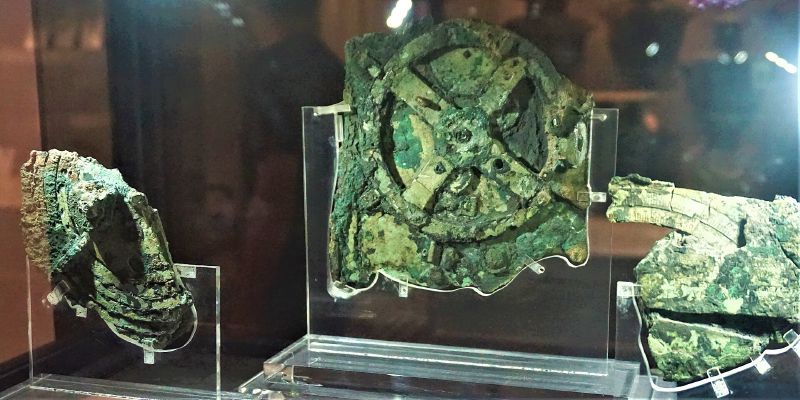
Divers found the wreck off the Greek island of Antikythera in 1901. Its cargo included bronze and marble statues, pottery, and glass and silver vessels. Among the haul was a corroded lump of bronze that turned out to be the device now known as the Antikythera mechanism. Researchers suspect the device was aboard a merchant ship that sank in a storm in the first century BC, sailing from Asia Minor toward Rome.
For most of the twentieth century the device stayed at the National Archaeological Museum in Athens, examined now and then by scholars who could see its gears but not explain them. X-ray studies in the 1970s and the 1990s looked at the fragments without settling how the gearing worked. Only 82 pieces of the mechanism survive, roughly a third of the original.
How the inscriptions became readable
A multinational group called the Antikythera Mechanism Research Project spent four years asking the museum for access before it was granted. Led by the mathematician and filmmaker Tony Freeth, the seventeen-person team turned to 3D X-ray computed tomography and new lighting techniques rather than handling the corroded metal directly. The scans doubled the number of inscriptions anyone could make out.
One of those inscriptions, described in a 2016 study, gave the ancient Greek calculation for how long Venus and Saturn take to return to the same point against the stars. Venus took 462 years, and Saturn 442. Greek astronomers placed Earth at the centre of the universe, so they had to describe each planet looping backward and forward across the sky to land where it was actually observed.
What the lost front panel showed
Earlier studies had already worked out the back of the mechanism, where inscriptions describe a display of the wider cosmos. The front stayed unexplained: a set of dials that once carried pointers for the sun, moon and five known planets circling Earth. Freeth’s team set out to explain how that front panel, which set out the Greek picture of the universe, might have worked.
Freeth’s 2021 model drew on three strands of evidence: astronomical cycles the Greeks had adapted from Babylon, mathematics associated with Plato’s Academy, and ancient Greek astronomical theory. Freeth called the result “a tour de force of ancient Greek brilliance”. It was, he said, the first model that fit every fragment and matched every inscription.
Could the Greeks actually build it?
The doubt is not about the arithmetic. It is about the metalwork. Adam Wojcik, the UCL mechanical engineer who worked on the model, said the nested tubes at its core were “where my faith in Greek tech falters”. Other researchers had tried to model the mechanism before, among them the London Science Museum’s Michael Wright, but the device’s corroded state made every attempt difficult.
Freeth’s team is now trying to build a working replica, using only tools and methods a Greek workshop of the period would have had. A skeleton from the same wreck, about 2,000 years old, could give the first DNA evidence from the wreck. It would not explain a single gear.