The sky is blue because air itself sorts sunlight by colour, scattering blue far more than any other colour it carries. It has nothing to do with the sea below it. Sunlight looks white, but it holds every colour of the rainbow, and the atmosphere splits that white light apart long before it reaches an eye.
Two explanations for the colour circulate anyway, and BBC Bitesize names them directly: that the sky reflects the ocean, and that oxygen itself is a blue gas. Water covers most of the planet, so the mirror idea has an obvious pull. Neither holds up.
more
What actually scatters the light
Sunlight travels as waves, and the length of a wave decides the colour an eye reads from it. NOAA’s satellite service puts a red wave at about 750 nanometres end to end, against roughly 400 for a blue or violet one. A nanometre is a billionth of a metre, small enough that a single human hair runs to about 50,000 of them across its width.
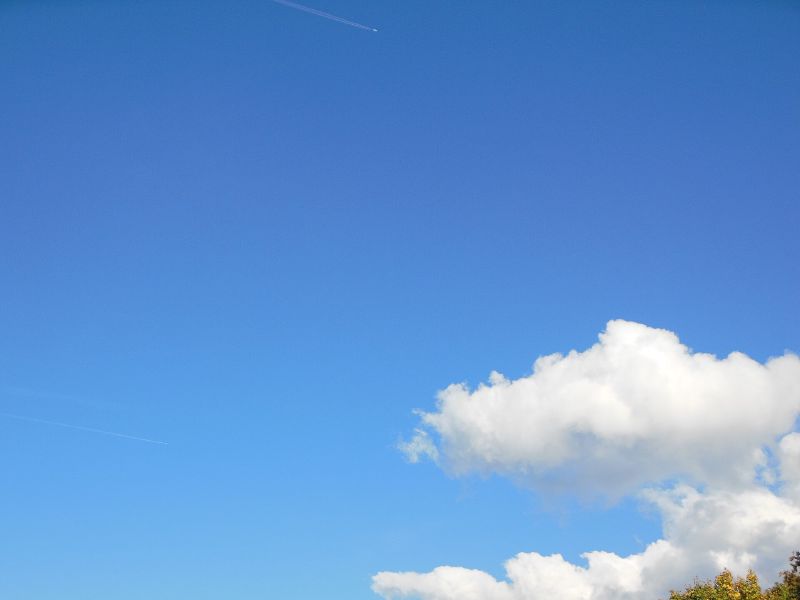
Air is packed with nitrogen and oxygen molecules. NOAA explains that blue and violet waves are the right size to bounce off those gas molecules in every direction. The longer waves, from red to green, mostly carry straight through. That scattered blue light reaches your eye from every open patch of sky at once. That is why the whole dome above you glows the same colour, not just the patch around the Sun.
The effect even has a name. It’s called Rayleigh scattering, after the physicist credited with working out how it behaves.
The colour violet should win, and doesn’t
Violet light has an even shorter wave than blue, so by the same rule the air ought to scatter it hardest of all and paint the sky purple. Two things stop that. Sunlight simply carries less violet than blue to start with, and the human eye is a weaker detector of violet once it arrives. NOAA adds a third reason: the upper atmosphere absorbs part of the violet before it ever reaches the ground.
Blue wins on quantity and on how well eyes pick it up, not because the physics favours it outright.
The horizon runs pale for a reason
Look straight up on a clear day and the blue runs deep. Follow it down towards the horizon and it fades towards a milky white. NOAA puts that down to distance. Light reaching you from low in the sky has crossed far more air than light falling straight down. It has been scattered and rescattered so many times over that the blue thins out before it arrives.
NASA’s Space Place adds a second cause. Light bounces off the ground and mixes back in with the sky’s own light, and that extra mixing pushes the colours back towards white.
What finishes the job at sunset
At sunset the Sun sits low, so its light crosses a far thicker slice of atmosphere before it reaches an observer. More of the blue scatters away over that longer path, so the reds and oranges that remain arrive with far less blue competing against them.
The two American agencies differ slightly on what happens next. NASA’s Space Place says small particles of dust, pollution and other aerosols scatter away still more of the surviving blue, letting purer red and yellow light through. NOAA puts the weight on larger particles instead, saying dust, pollution and water vapour reflect and scatter the reds and yellows themselves, which is what can set a whole western sky glowing.
Skies on other worlds
Change the atmosphere and the colour changes with it. Venus carries an atmosphere around 90 times as dense as Earth’s, which makes it harder for sunlight to get through. The longer wavelengths win out, so its sky looks orange, as if the planet sat permanently at sunrise. The Moon has next to no atmosphere at all, and with nothing there to scatter sunlight, its sky stays black day and night alike.
Mars sits between the two. Its atmosphere is thin and mostly carbon dioxide, laced with fine dust that scatters light differently from Earth’s gases. By day the Martian sky looks orange or reddish. Around sunset the sky near the Sun turns blue-grey instead, a swap NASA’s Mars Pathfinder lander photographed directly. Earth runs blue by day and red at dusk. Mars runs the reverse.
The question a satellite still asks
A child’s question turns out to matter to more than curiosity. Sunlight carries the energy that heats the planet. NOAA notes that the climate depends on how much of it the atmosphere scatters, how much escapes back to space, and how much land, ice, cloud and smoke absorb instead.
The same scattering runs in reverse from orbit. Instruments on the GOES-R satellites read the intensity of light at different wavelengths bouncing back off the Earth’s surface and atmosphere. Scientists use those readings to work out temperatures on the ground and in the air above it. Next time the blue overhead fades to pale white at the horizon, a satellite somewhere is reading the same light, from the other side.