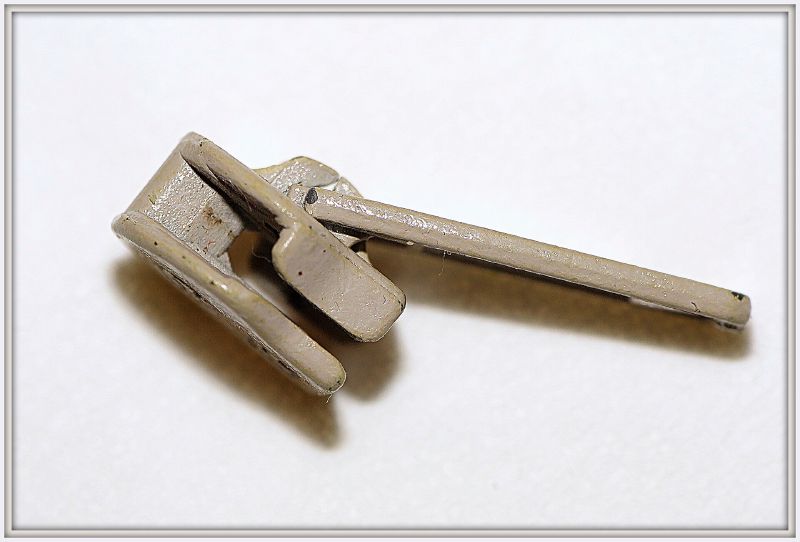
The zip you pulled this morning started life as a boot fastener that jammed, sold almost nothing, and outlived its inventor without ever earning its name. Whitcomb Judson of Chicago patented his “clasp-locker” in 1893 to spare people the long laces on their boots. The public at that year’s World’s Fair in Chicago largely walked past it. Two decades later a Swedish-American engineer, Gideon Sundback, rebuilt the idea into something reliable, and only then did it start to sell.
more
BBC Future quotes the historian Robert Friedel, author of a whole book on the zip. He says it could be argued that the aeroplane or the electronic computer took less time to invent. What follows is how a device that should have failed instead ended up on trousers, tobacco pouches and early spacesuits.
Before the zip
For most of history, clothes closed with laces, buttons and hooks. The Lemelson-MIT programme points out that the shoelace, the button and the safety pin all existed in some form across many cultures for thousands of years. The zip is different. Lemelson-MIT credits it to one American inventor.
Before that inventor came a false start. In 1851 Elias Howe, the man behind a sewing machine, patented what he called an “Automatic, Continuous Clothing Closure”. BBC Future is unkind about it. The device was awkward to use, likely to rust, and liable to snag or burst open at the worst moment. It was also so dear that it roughly doubled what a pair of trousers cost in the shop.
Howe never pushed it. YKK, today’s largest zip maker, suggests the success of his sewing machine drew him away from the closure. ThoughtCo puts it more sharply: by letting the patent lie, Howe gave up his chance to be remembered as “Father of the Zip”. British GQ adds that he was already making a fortune from his other invention, so he paid little attention to marketing this one.
So the idea sat. BBC Future says it went unnoticed and unvalued for over 40 years. Meanwhile the problem it was meant to solve stayed in plain sight. YKK notes that boots of the period fastened with a row of buttons, and that doing them up was tedious. The Fashion History Museum makes the wider point that most inventions are not one person’s work. The light bulb, the telephone and the zip all grew from many people improving on what came before.
Judson and the clasp locker
Whitcomb Judson was no beginner when he turned to boots. By the end of the 19th century he held about a dozen patents for mechanical work, including motor improvements and railway brakes. His target this time was the long lace that men’s and women’s boots both used.
more
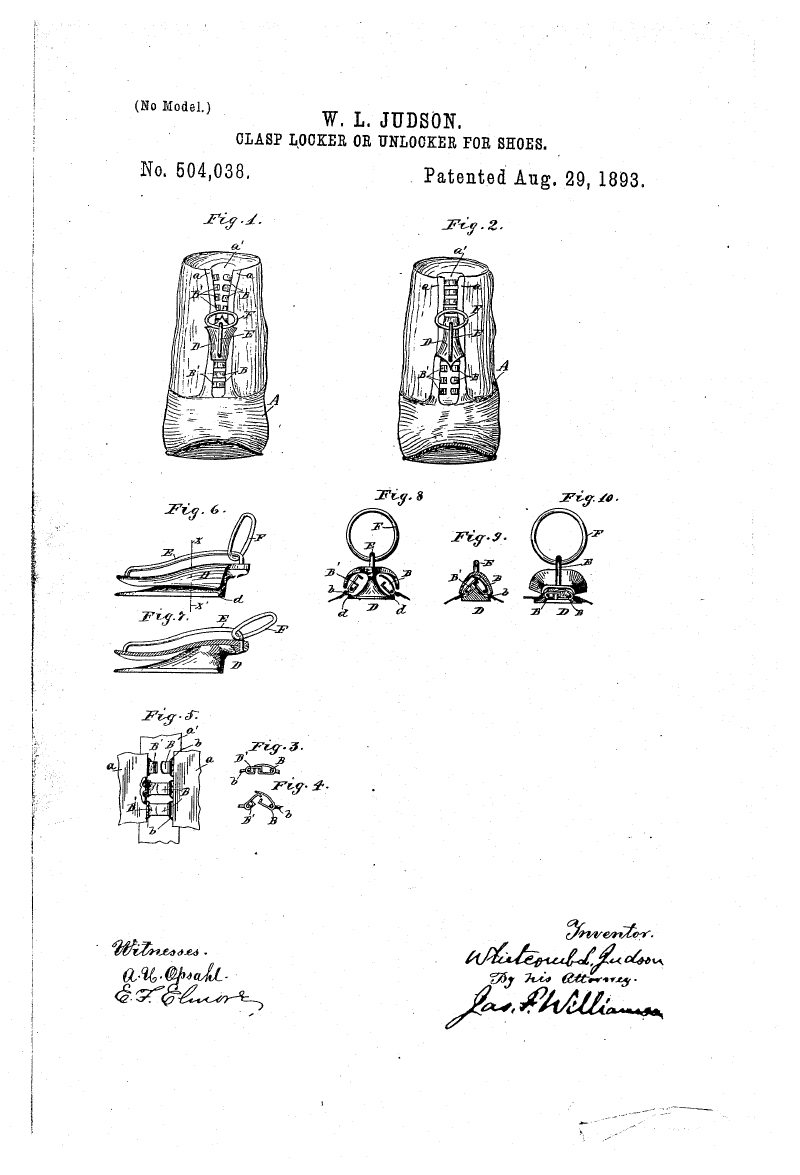
The patent office was slow to agree. Invention & Technology magazine dates his first application to November 7, 1891, under the title “Clasp Locker or Unlocker for Shoes”. YKK says that 1891 filing nearly failed because so many shoe fasteners were being patented at the time. An improved version cleared in May 1893, by YKK’s account. Lemelson-MIT gives the grant date as August 29, 1893. The patent number was 504,038.
The drawing shows a high-top shoe. Along one edge of the opening runs a row of hook-like clasps, with matching catches on the other side. Between them sits a slide, which Judson called a “guide”, that fed the two rows in at one end and pushed them out locked at the other. The patent itself admits that closing the clasps one at a time by hand was “a tedious operation”. The guide came off after each use and had to be turned round for opening or closing. Invention & Technology judged the whole thing complicated and doubted it worked well, or at all.
It did work, after a fashion. Lemelson-MIT says the prototype was clumsy and often jammed, but Judson and his business partner, Lewis Walker, wore it sewn into their own boots. Britannica describes the mechanism plainly as hooks and eyes with a sliding clasp to open and close them.
A fair, a lawyer and a company
Judson took the clasp locker to the World’s Columbian Exposition in Chicago in 1893. British GQ notes that the same fair gave the public its first Ferris wheel. The fastener drew far less interest. Lemelson-MIT says the public largely ignored it.
Invention & Technology calls Walker one of the central puzzles of the zip story. Invention & Technology describes him in 1893 as a 38-year-old lawyer who had built a decade-long practice in commercial contracts. His wife’s family had lost much of its money when its bank failed in the turmoil leading to the Panic of 1893. He backed Judson anyway. When the Universal Fastener Company formed in Chicago in 1894, Walker was a major participant, and he showed off a pair of shoes fitted with the latest fastener everywhere he went.
Time magazine later wrote that the device worked badly but impressed Walker at once. Colonel Walker spent about 20 years and roughly $1,000,000 raised from many backers before it paid.
The fastener kept changing. British GQ reports that Judson registered a further patent in 1896, USP 557,207. Invention & Technology says one of his 1896 patents anticipated the principle the modern zip relies on, though not in a form that worked. JSTOR Daily, citing Lewis Weiner in Scientific American, says that by 1904 the partners had refined the design and patented a machine to make it. They also had a slogan: “A Pull and It’s Done”.
The product still failed. JSTOR Daily lists the faults: sharp, awkward hooks that tore cloth and sometimes sprang open. YKK blames the same habit of pulling itself apart for its poor sales in Judson’s lifetime. The Fashion History Museum says the company planned to sell an improved version as the “Judson C-curity Fastener”. British GQ adds that the firm moved several times and ended up in Hoboken, New Jersey, as the Automatic Hook and Eye Company.
Judson’s other interests did not help. BBC Future says he spent most of his life on a “Pneumatic Streetcar” that also failed. Invention & Technology describes another of his patents, a street railway driven by long tubes spun underground by compressed air. It calls him an ambitious, self-made mechanic who leaned towards inventions too clever to work.
He died in 1909. Lemelson-MIT notes that he never heard the word “zipper” and never saw his idea succeed.
Sundback’s separable fastener
The man who made it work arrived as an employee. JSTOR Daily says the company hired Gideon Sundback, a Swedish-American engineer, in 1906. ThoughtCo dates his birth to 1880 and calls him an electrical engineer.
more
He rose fast. BBC Future, citing Steve Silverman’s book Einstein’s Refrigerator, says his skill, and possibly his marriage to the plant manager’s daughter, made him head designer at Universal. The Fashion History Museum names her as Elvira Aronson. She died in 1911, and the museum says the grieving Sundback threw himself into his work. YKK tells it the same way.
From hooks to scoops
The dates of his breakthrough vary by source. YKK says he patented the “Hookless Fastener No. 1” on April 29, 1913, a date now marked as National Zipper Day. Invention & Technology puts the decisive model in December 1913, when Sundback showed Walker and his partners what it calls Hookless #2. Walker first called it the Hookless Hooker.
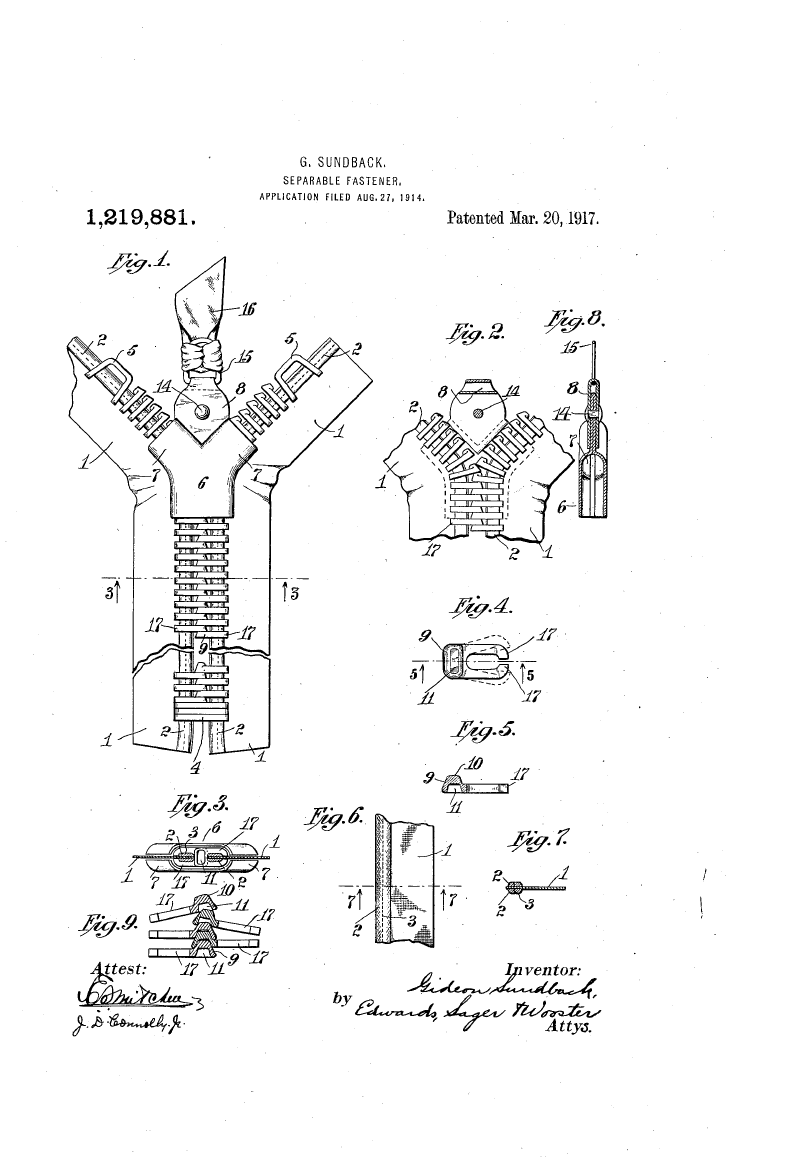
That model was the modern zip, by Invention & Technology’s account. The fastening parts no longer looked like hooks and eyes. They became small scoops that sat tight when the slide joined them and let go when it parted them. The magazine points to a strange property of the design. A single pair of scoops holds nothing on its own, and the grip only exists when a whole run of them is locked and both ends are secured.
BBC Future lists what Sundback changed.
- He increased the number of fastening elements.
- He set two rows of teeth facing each other.
- He gave each tooth an indent and a bump, so the slider could pull the rows into one piece.
- He widened the gap that guided the teeth through the slider.
The sources disagree on the count. ThoughtCo says the elements went from four per inch to 10 or 11. The National Inventors Hall of Fame’s inductee page says four to ten. The Fashion History Museum says four to eleven.
His patent for the “Separable Fastener” came in 1917. JSTOR Daily notes that he applied for it that year and that it was metal and hookless, close to the zip we know. Walker raised fresh capital and reincorporated as the Hookless Fastener Company, with himself as president.
The machine that made it pay
Sundback did not stop at the fastener. BBC Future, again following Petroski, says he also built the machine that made it, called the “S-L” or scrapless machine. It started from a Y-shaped wire, cut scoops, punched dimples, and clamped each scoop to a cloth tape in one continuous chain. In its first year it turned out several hundred feet of fastener a day. The Hall of Fame dates the machine to 1923 and calls it central to the zip’s later commercial success. JSTOR Daily says he patented this waste-free machine in 1923.
His son Eric remembered a man devoted to quality. “He didn’t quit when he had something partially done,” he told Carnegie Mellon University, according to the Hall of Fame.
The welcome was cool at first. The Hall of Fame says Hookless No. 2 met a lukewarm reception in 1914, because buttons and clasps were more popular and earlier designs had earned a poor name.
The war gives it a job
The First World War gave it customers. In 1917 a New York tailor, Robert J. Ewig, began putting the fasteners into money belts. The belts became an instant favourite with US sailors, whose uniforms had no pockets. JSTOR Daily says nearly all of the company’s 24,000 sales that year were for those belts. In 1918 the US Navy ordered fasteners for 10,000 flying suits.
Lemelson-MIT says the US Army also put zips on troops’ clothing and gear during that war.
Meadville, Pennsylvania
The business found a home in a small Pennsylvania city. Visit Crawford County, the county’s tourism office, says the Hookless Fastener Company set up in Meadville in 1913. Time reported that it began there in a shack rented for $300 a year. The firm made “Talon” fasteners and grew into the largest of about 16 US zip makers.
The same Time report gave a sense of scale. Trade estimates put Hookless output at about 35,000,000 zips a year, around 75% of US production. Fortune, Time noted, had estimated Hookless gross income at $4,500,000 in 1931. The company’s one worry was Japan, which had sold 26,000,000 zips in the US the previous year despite a 66% tariff. Walker proposed to rename the business Talon, Inc.
Visit Crawford County says Meadville became known as “Zipper City, USA”. The skilled toolmakers it trained earned the city a second nickname, “Tool City, USA”.
How it got its name
For three decades nobody called it a zip. The name came from a boot.
Lemelson-MIT credits B. F. Goodrich with the word “zipper”, an imitation of the sound, after his firm put the fastener on galoshes in 1923. Britannica goes further and names the person: B. G. Work of the B. F. Goodrich Company, in 1923, for overshoes. Invention & Technology says the boots went on sale as Zipper Boots, and that this gave the fastener its American name.
BBC Future, following Petroski, reports that Goodrich is said to have liked the zipping sound so much that he named the system after it. The Hall of Fame tells the story slightly differently. It says the wartime fame of the fastener led Goodrich to try it, and that the company named the boot, not the fastener, the “Zipper”.
JSTOR Daily adds two details. The boots let wearers close them fast and with one hand. The word “zip” had existed since the mid-1800s, meaning to move fast, and Goodrich trademarked “zipper” for the boot model.
Not every source agrees on the year. The Fashion History Museum dates the name to 1924. Most sources, including Lemelson-MIT and Britannica, give 1923.
The boot did not last as long as the word. JSTOR Daily says the boots had lost favour by the Great Depression, but the name stuck, and so did the public’s liking for the fastener.
Fashion and the fly
Boots and tobacco pouches were the zip’s first real markets. ThoughtCo says it took another 20 years to persuade the fashion trade to use it seriously on garments.
Invention & Technology argues that novelty carried the zip through those years. The magazine lists a run of new uses that kept Meadville prosperous, even through the Great Depression.
- tobacco pouches
- handbags
- rubber overshoes
- children’s jump suits
- sweaters
Children came early. ThoughtCo describes a 1930s sales campaign that sold zipped clothes as a way to make young children self-reliant, because they could dress themselves.
Schiaparelli’s coloured teeth
High fashion took longer. Invention & Technology says the boldest early adopter was Elsa Schiaparelli. Plastic zips in colour, made of celluloid, reached the market in the mid-1930s. Schiaparelli’s 1935 collection carried bright zips in contrasting colours, placed to draw the eye.
The V&A’s timeline of her life records that she launched the colour Shocking Pink with a perfume of the same name. It also notes that she moved her Paris salon to the Place Vendôme. The Fashion History Museum says she and the couturier Charles James both liked shiny celluloid zips made in Canada by the Lightning Zipper Company.
Invention & Technology admits her approach had narrow appeal. It still prepared the ground for 1937, when Paris designers turned to slim, trim lines and the smaller zips now coming out of Meadville suited them. An advertising push promised women an end to “Gaposis”, and that settled it.
The battle of the fly
Men’s trousers were the other front. ThoughtCo calls 1937 the year the zip beat the button in the “Battle of the Fly”. French designers praised zipped flies, and Esquire called the zip the “Newest Tailoring Idea for Men”. BBC Future places that Esquire verdict in the late 1930s.
One claimed virtue has become a favourite line. British GQ quotes a journal of the time promising that a zipped fly would rule out “the possibility of unintentional and embarrassing disarray”.
Rebel jackets
After the Second World War the zip changed its meaning. BBC Future says Hollywood used biker jackets covered in zips as shorthand for rebellion, as on Marlon Brando’s character in The Wild One. By the 1970s, BBC Future notes, the Rolling Stones album Sticky Fingers carried a pair of jeans on its cover with a real zip that worked.
Practical gains followed. ThoughtCo says the next big step came with zips that open at both ends, such as those on jackets. BBC Future adds that nylon arrived in the 1960s.
Where it stands now
The zip’s centre of gravity moved east. YKK traces its own start to January 1934, when Tadao Yoshida opened a Tokyo firm called San-es Shokai to process and sell zips. He built a plant in Tokyo in 1938. Air raids destroyed it in March 1945, and he restarted after the war in Uozu as Yoshida Kogyo Kabushiki Kaisha, or YKK.
Machines drove its growth. YKK says it brought a US-made chain machine to Japan in 1950 and put it to practical use in 1953. It built the CM3 in 1959 and the CM6 in 1964, which YKK says led the world in mass production quality at the time. In 1958 it developed an aluminium alloy, 56S, that opened new markets for its zips.
JSTOR Daily follows the rest of the industry. After the Second World War, wrecked German zip factories and new polymers led to plastic zips. Annual production passed 2 billion by the 1970s, and YKK led the industry by the 1980s.
How big the business is
The numbers now are large. YKK says it makes roughly 3 million kilometres of zips a year. The National Inventors Hall of Fame reported YKK’s yearly revenue at $10 billion. British GQ wrote that YKK controls almost half the world market.
GQ also pointed to Qiaotou, a Chinese city south of Shanghai better known for buttons. It claimed Qiaotou makes 80 per cent of the world’s zips, some 200 million metres a year.
Talon survived too. British GQ says the company moved to Pennsylvania, took the Talon name, and led the trade through the 1960s and 1970s. At Los Angeles Fashion Week in March 2017, JSTOR Daily reports, Talon showed what it called the world’s longest zip, 3.1 miles long.
Still changing
The zip keeps finding new work. JSTOR Daily says medical zips sometimes now replace sutures. BBC Future describes a Polish company, Blessus, that uses hidden zips to change a garment’s cut. It also mentions a magnetic zip from DNS Designs, later sold by Under Armour as the Magzip, which closes one-handed.
Not every field kept it. Early spacesuits used two heavy brass zips pressing a rubber seal, BBC Future says, but modern suits have dropped them because the seal did not hold up over long use.
The Fashion History Museum says people sometimes call the zip a Canadian invention, wrongly. The confusion comes from Sundback, who sold foreign rights to a British firm whose Canadian subsidiary, Lightning, made him president in 1925. He held that post until his death in 1954.
Meadville still tells its part. Visit Crawford County invites visitors to walk the historic downtown and see local exhibits on the city’s zip-making past.
Starter guide
Read, and see, these to follow the zip from patent to page.
- Zipper: An Exploration in Novelty (Robert Friedel, 1996). The historian BBC Future quotes on the argument that the aeroplane or the computer arguably took less time to invent than the zip.
- The Evolution of Useful Things (Henry Petroski). BBC Future draws on this book for Judson’s clasp locker, Sundback’s machine and the Goodrich name.
- Automatic, Continuous Clothing Closure (Elias Howe, 1851). The first patent BBC Future traces, costly and prone to snagging.
- Clasp Locker or Unlocker for Shoes (Whitcomb Judson, 1893). Patent 504,038, the device Judson took to the Chicago World’s Fair.
- Hookless fastening device (Gideon Sundback, 1913). The design BBC Future says paved the way to the modern zip.
- Separable Fastener (Gideon Sundback, 1917). The patented version with two facing rows of interlocking teeth, in BBC Future’s account.
- The S-L scrapless machine (Gideon Sundback, 1923). The machine that cut and clamped scoops from Y-shaped wire, which BBC Future credits with the zip’s take-off.
- Goodrich zipper galoshes (B. F. Goodrich Company, 1923). The rubber boots Lemelson-MIT names as the origin of the word “zipper”.
- Newest Tailoring Idea for Men (Esquire, 1937). The magazine verdict BBC Future credits with bringing the fashion trade round to the zipped fly.